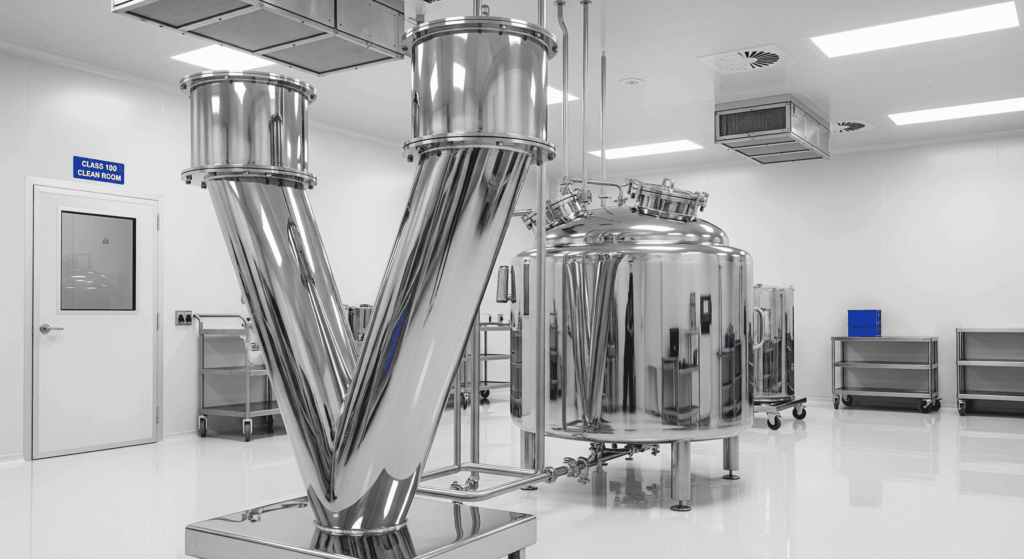
In the pharmaceutical industry, equipment isn’t just an integral partner in compliance. Each tank, blender, and weld finish is a factor in whether an organization is able to pass audits without a hitch or has to spend long hours resolving corrective actions.
Automation is also taking over the pharma space. Custom stainless steel from Ability Fabricators – like sloped V-blenders and passivated tanks – fits these modern GMP spaces, enabling quick validation and scalability.
This is the reason that makes stainless steel a pharmaceutical processing element; when constructed in accordance with Good Manufacturing Practice (GMP) guidelines, it is the basis of scalable, safe, and regulated production.
GMP guidelines are in place for one reason: the safety of patients. The stainless steel, when constructed correctly, checks a large part of the GMP box for cleanliness, durability, as well as validation and long-term reliability. Experienced manufacturers like Ability Fabricators design GMP-ready stainless steel equipment-blenders, tanks, IBCs, and material handling systems, specifically for pharmaceutical workflows across North America.
Let’s take a look at the meaning of GMP. What it actually is for equipment made of stainless steel, and what pharmaceutical manufacturers must ask before approving fabrication.
Good Manufacturing Practices are enforced worldwide by regulatory bodies like the FDA, EMA, and WHO. These guidelines not only govern how drugs are manufactured but also how equipment must be constructed, designed, and cleaned as well as maintained.
Stainless steel equipment excels here because it resists corrosion, doesn’t react with APIs, and retains structural integrity under harsh pharmaceutical conditions.
If it isn’t documented, it didn’t happen – GMP lives by this rule. Equipment must support IQ (Installation Qualification), OQ (Operational Qualification), and PQ (Performance Qualification) under standards like 21 CFR Part 11.
This means manufacturers must provide:
Custom fabricators who understand GMP build documentation into the process, not as an afterthought.
Not all stainless steels are created identically, particularly in the pharma industry.
It is a gold standard to use stainless steel in pharmaceutical processing. Low carbon levels, as well as molybdenum, significantly increase the resistance to pitting, corrosion, and stress cracking in the presence of chloride or acidic environments.
304 stainless steel is suitable for low-corrosion or non-critical applications, but it’s usually not recommended for pharmaceutical processes that require high purity.
For injectable or formulations that are subject to aggressive regulations and industry guidelines generally recommend 316L or stainless steel that is dual-certified 316.
GMP guidelines require smooth surfaces that do not give bacteria a safe place to thrive and conceal. For areas that are in contact with products roughness of the surface must generally be less than 0.8 μm, as measured using profilometry following the fabrication.
Electropolishing, a modern technique, can reduce surface roughness even more – to Ra 0.04 μm or less. 0.4 um. This creates mirror-like finishes:
Every weld must be crevice-free and properly passivated to remove free iron and restore the protective chromium oxide layer.
Powder blending is one of the most contamination-sensitive stages of pharmaceutical production. V-blenders and double cone blenders must ensure uniform mixing while eliminating dead zones and residue traps.
Stainless steel tanks and Intermediate Bulk Containers (IBCs) handle everything from raw materials to finished formulations. GMP demands that these vessels maintain sterility, resist corrosion, and support repeatable cleaning cycles without surface degradation.
Material handling often flies under the GMP radar – until it causes an audit issue.
Good GMP design is invisible when it’s done right – and painfully obvious when it’s not.
Dead legs must be eliminated or kept below 3D pipe diameters to prevent stagnant product buildup. Horizontal surfaces should have 15–20% slopes for full drainability, and internal edges should have a radius greater than 0.25 inches to block residue accumulation.
CIP systems are essential for GMP efficiency. Well-designed CIP integrates spray balls that deliver 100% coverage, validated through riboflavin testing.
Alkaline detergent wash
For sterile processes, SIP uses pressurized steam – often at 140°C – to achieve bioburden levels below 10 CFU/100 cm². Equipment must withstand repeated thermal stress without warping, cracking, or surface degradation.
Not every stainless steel fabricator understands pharmaceutical GMP – and that gap shows during audits.
When evaluating Pharmaceutical Manufacturing Equipment Suppliers, look for partners who:
Ability Fabricators addresses common GMP pitfalls through precision fabrication, orbital and TIG welding, validated passivation, and pressure testing at 1.5x operating pressure to ensure leak-free performance.
Before approving stainless steel pharmaceutical equipment, confirm the following:
GMP compliance isn’t something you bolt on after fabrication. It’s engineered from the first weld to the final surface finish. Stainless steel pharmaceutical processing equipment, when designed and built correctly, becomes a compliance asset – not a liability.
Ability Fabricators supplies GMP-ready stainless steel equipment – blenders, tanks, IBCs, platforms, and material handling systems – to pharmaceutical manufacturers across North America. When precision, documentation, and long-term reliability matter, partnering with GMP experts isn’t optional.
It’s how you protect your product, your patients, and your process.
GMP ensures equipment is designed, built, and maintained to prevent contamination, ensure consistency, and protect patient safety.
Stainless steel is non-reactive, corrosion-resistant, easy to clean, and capable of withstanding repeated sterilization cycles.
316L stainless steel is preferred due to its low carbon content and superior resistance to corrosion and pitting.
Product-contact surfaces typically require a surface roughness of Ra ≤ 0.8 µm to minimize bacterial adhesion.
Blenders, tanks, IBCs, lifts, and material handling systems all require GMP-compliant design and fabrication.